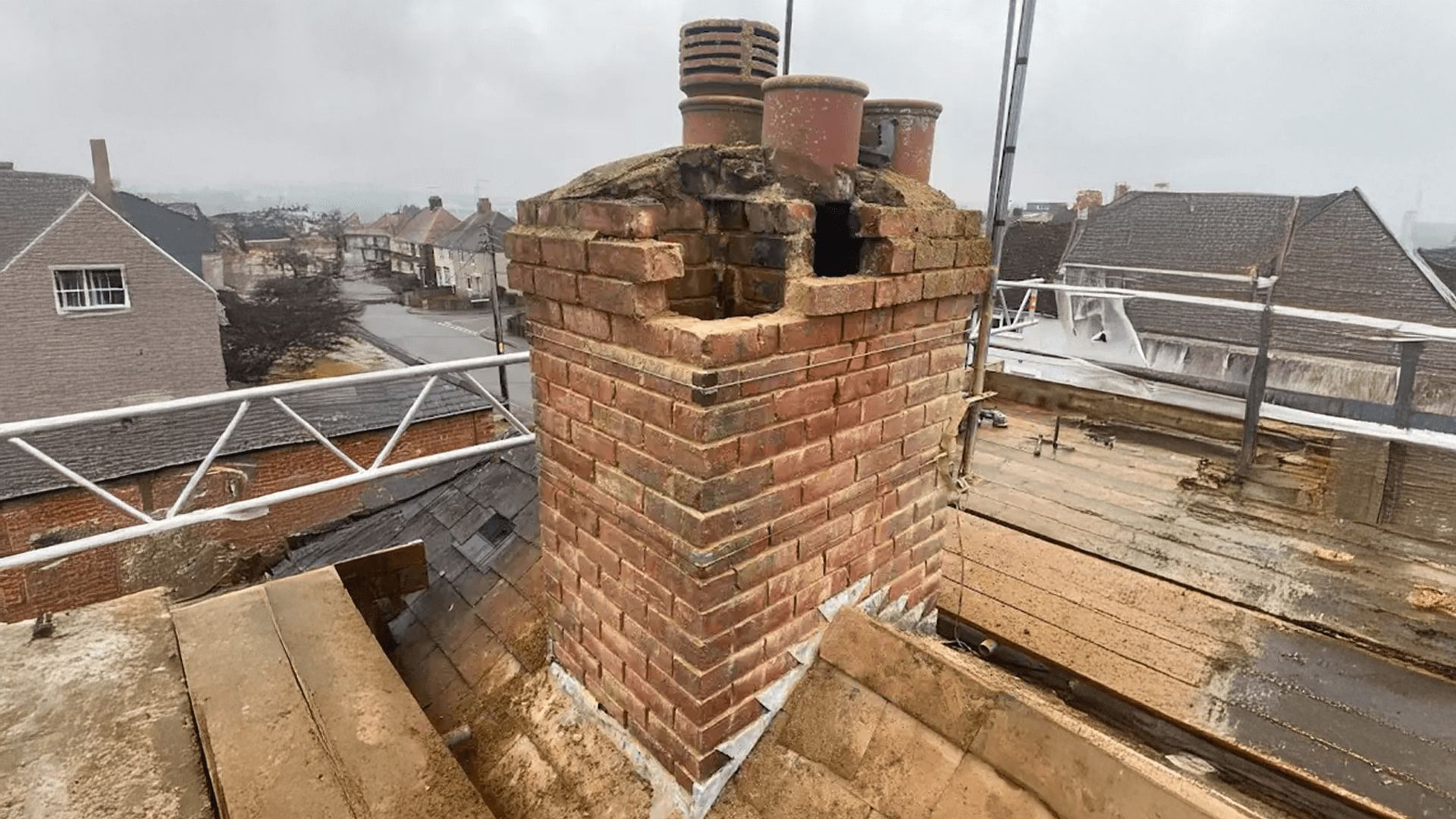
To understand a chimney leak, it helps to follow the water, from the moment it lands on the stack to the stain it eventually leaves inside. Water is patient and it is thorough, and tracing its path is the key to stopping it. It begins at the top. Rain falling on the crown of the stack should run off the flaunching and clear of the pots, but where that mortar crown has cracked, water no longer runs off; it sits, seeps into the joints around the pots, and begins its journey down. A failed flaunching is often where the water first gets in. From there it travels through the masonry. Once past the crown, or entering through perished pointing on the faces of the stack, water soaks into the mortar and brick and works its way downward under gravity, following the path of least resistance through the joints and any cracks it finds. This is slow, hidden travel, and it can carry the water a surprising distance from where it entered. Along the way it meets the defences, and finds their weaknesses. A sound flashing at the roof junction, or a lead tray within the stack, should turn the water back out; but where the flashing has lifted or the tray is missing or defective, the water slips past and continues down, now inside the building’s line rather than outside it. Each failed defence is a place the water was meant to be stopped and was not. Finally it shows. Having travelled down through the stack, the water emerges where it can, on the chimney breast, a ceiling or a wall, appearing as the damp patch or stain that first tells the homeowner something is wrong, often well below and to one side of where it entered. The stain is the end of the journey, not its beginning, which is exactly why treating the stain does nothing. It is worth adding that the water’s journey is rarely a straight drop, which is what makes a leak so easy to misdiagnose. Following the path of least resistance, water may run along a mortar bed, track sideways across a hidden ledge, or be led astray by a crack before reappearing far from any point directly below where it entered. This is why a stain in one place can have its source somewhere quite unexpected, and why the instinct to look for the fault directly above the stain so often misleads. Only by understanding that water travels where the structure lets it, not merely straight down, can its true path be worked out and its entry point found. Following the water backwards, from the stain to its true point of entry, is how a leak is properly diagnosed. The repair then blocks the water at its source, on the crown, the pointing, the flashing or the tray, wherever the journey actually began, so that there is no longer any path for it to take. For a homeowner in Longfield Green, understanding that a leak is a journey, with a beginning far from where it ends, is the key to seeing why the cure lies at the top of the stack and not on the wall where the damp appears.
Some leaks give up their secret at a glance; others hide, and it is with the stubborn ones that a contractor’s real quality shows. The willingness to keep looking until the true source of a leak is found, rather than settling for a plausible guess, is what separates a lasting cure from a repeated disappointment. That persistence is something High Pitch Roofing brings to the awkward cases in Longfield Green. Where a leak has defeated previous repairs, or where the damp shows in a puzzling place far from any obvious fault, the response is not to shrug and repoint the nearest likely spot but to trace the water properly, following it back to where it truly enters. A leak is not beaten until its source is found. This takes patience and method rather than assumption. Considering every path the water might be taking, ruling possibilities in and out, and looking beyond the obvious until the real entry point emerges is painstaking work, but it is the only way to be sure of curing a stubborn leak. A guess, however educated, that is not confirmed is just a guess. It takes a refusal to be beaten, too. A difficult leak can be genuinely frustrating, and the temptation to declare a likely-looking repair the answer and move on is real, but a persistent contractor resists it, staying with the problem until it is genuinely understood. That determination is exactly what a homeowner plagued by a recurring leak most needs. There is honesty in it as well. Rather than claiming to have fixed a leak that has merely been guessed at, the persistent approach is straight about what has been found and why the repair should work, so the homeowner’s confidence rests on understanding rather than hope. A cure explained is worth more than a cure asserted. There is a cost to this persistence that a firm has to be willing to bear, which is why not every contractor offers it. Tracing a stubborn leak properly takes time that a quick guess would not, and it is tempting to price and perform the easy, likely-looking repair instead and move on. Choosing the harder, thorough course, because it is the one that actually solves the problem, is a commitment to the result over the quick turnaround, and it is exactly that commitment a plagued homeowner is looking for. It is worth adding that persistence and humility go together here. Part of tracing a leak honestly is being willing to say that the first attempt has not settled it, and to keep looking, rather than insisting a repair has worked when the damp returns. That readiness to stay with a problem until it is genuinely beaten, rather than declaring victory prematurely, is the difference between a leak managed and a leak cured. For a homeowner in Longfield Green battling a leak that will not be pinned down, a contractor persistent enough to trace it to its real source, and honest about what they find, is worth a great deal. Combined with skilled work and a guarantee, that tenacity in the face of a stubborn problem is a large part of what finally turns a recurring, maddening leak into one that is genuinely and permanently solved.

Four decades of refined craftsmanship and industry knowledge, ensuring your chimney is in the safest possible hands.
Our dedicated team in Longfield Green is committed to traditional values, direct communication and integrity in every quote.
We believe in making your chimney repair as straightforward and stress-free as possible. From your initial enquiry to the final inspection, our family-run team ensures clear communication, professional conduct, and a high standard of safety, keeping you informed at every stage of the build.
We begin with a thorough inspection of your chimney conducted by an experienced tradesman, not a salesman.
Once the project is approved, our skilled team carries out the work using high-quality materials and proven techniques.
Upon completion, we conduct a rigorous walkthrough to ensure every detail meets our 40-year standards of excellence.
We know that chimney repair options are a big decision. Here are the answers to the most common questions we receive regarding chimney repairs in Longfield Green.
Flashing is the lead detailing that seals the junction where the chimney meets the roof, and it’s one of the most common leak points on any property. It should be replaced when the lead cracks, lifts, or corrodes, as a worn seal will let water track into the roof and down into your home.
Both protect the top of the flue, but a cap typically seals or covers an unused chimney while still allowing ventilation, whereas a cowl sits over an active flue to improve draught and keep out rain and birds. We can advise which is right depending on whether your chimney is still in use.
Yes, we provide chimney maintenance and repairs across Longfield Green and the wider region. As a local, family-run team we cover the surrounding areas and are happy to arrange a site visit to assess your chimney. Get in touch through the contact form or call us to book yours.
Every quote comes from an experienced roofer, never a salesman. This means the assessment of your chimney is technically accurate and the price reflects the actual work needed. Call us or complete the contact form and one of our roofers will be in touch to arrange an inspection.
Ready to repair your chimney? Fill out the form below to arrange a site visit. One of our experienced chimney experts will provide a thorough inspection and a detailed, no-obligation quote tailored to your specific project requirements.
Your chimney is exposed to the elements every day of the year, making it one of the most vulnerable parts of any property. While it’s easy to overlook, even minor chimney damage can quickly develop into costly structural problems if left untreated. Whether you’ve spotted loose bricks, cracked mortar, damp patches, or a leaning chimney stack, arranging professional chimney repair as soon as possible can help protect both your home and your investment.
If you’ve been searching for chimney repair near me, chances are you’ve already noticed signs that something isn’t right. A trusted chimney repair company can inspect the structure, identify the root cause of the problem, and recommend the most effective chimney repair service before the damage becomes more extensive.
Chimneys face constant exposure to rain, frost, wind, temperature changes, and pollution. Over time, these conditions naturally weaken brickwork and mortar joints, allowing moisture to penetrate the structure. Once water enters the chimney, deterioration often accelerates.
Properties in Longfield Green, particularly older homes, are especially prone to weather-related wear. Regular maintenance and timely chimney repair services help prevent small defects from turning into major structural repairs.
Water penetration is one of the leading causes of chimney deterioration. If moisture is entering your property through damaged flashing, cracked masonry, or a failing chimney crown, you’ll likely require a leaking chimney repair. Professional solutions may include:
Chimney flashing repair
Chimney flashing leak repair
Chimney leak repair
Waterproofing damaged brickwork
Left untreated, water ingress can lead to internal damp, mould growth, and weakened masonry.
Another frequent issue is deteriorating mortar. As mortar ages, it begins to crumble, allowing bricks to loosen and creating pathways for water. Repairs often involve:
Chimney mortar repair
Chimney masonry repair
Chimney repointing
Chimney tuckpointing
Where bricks have become damaged or unstable, brick chimney repair or chimney brick replacement restores both appearance and structural integrity.
For severely deteriorated stacks, larger projects such as chimney rebuilding, chimney reconstruction, or complete chimney restoration may be the safest long-term solution.
Visible cracks should never be ignored. Even hairline fractures can allow moisture into the chimney, gradually worsening during freeze-thaw cycles. Depending on the severity, repairs may include:
Chimney crack repair
Cracked chimney repair
Structural masonry repairs
If a chimney begins leaning or moving away from the building, immediate attention is essential. A leaning chimney repair often involves stabilising the structure before rebuilding damaged sections.
Similarly, chimney settling repair may be required where movement in the property’s foundations has affected the chimney stack. These types of structural issues should always be assessed by an experienced chimney repair specialist.
The upper section of a chimney receives the greatest exposure to the weather, making it particularly susceptible to damage.
A damaged crown allows rainwater directly into the chimney structure, often requiring:
Chimney crown repair
Cracked chimney crown repair
Chimney crown replacement
Likewise, damaged chimney caps should be repaired promptly to prevent rain, birds, and debris entering the flue. Common services include:
Chimney cap repair
Chimney cap replacement
Chimney cap leak repair
Some properties use chase covers rather than traditional caps, in which case chimney chase cover repair or chimney chase cover replacement may be necessary.
Water remains one of the biggest threats to any chimney. Even sound brickwork absorbs moisture over time, which is why many homeowners choose professional chimney waterproofing.
A breathable chimney waterproof sealant helps reduce water absorption while allowing trapped moisture to escape naturally. Where water has already caused damage, repairs such as chimney water damage repair or chimney moisture repair should be completed before waterproofing is applied.
Not every chimney problem is visible from outside the property. Internal components are equally important for safe operation.
Damaged dampers can reduce airflow and heating efficiency, making chimney damper repair or chimney damper replacement necessary.
Similarly, damaged liners can create serious safety concerns. Professional contractors can carry out:
Chimney liner repair
Chimney liner replacement
These repairs help maintain safe ventilation while improving the overall performance of the chimney.
Some chimney problems require immediate attention. Storm damage, collapsing brickwork, major leaks, or significant structural movement should never be left unattended.
An emergency chimney repair service can quickly stabilise the structure, preventing additional damage and reducing repair costs. Many companies also offer same day chimney repair for urgent situations where safety is a concern.
Acting quickly often prevents a relatively straightforward repair from becoming a complete rebuild.
Routine inspections remain one of the most effective ways to protect your chimney and avoid expensive repairs.
A professional chimney inspection and repair service can identify early signs of deterioration long before they become visible from the ground. Small repairs carried out early are typically far more affordable than extensive structural restoration later.
Whether you need affordable chimney repair for minor maintenance or a full reconstruction, regular inspections help extend the lifespan of your chimney and keep your property safe.
Chimney problems rarely improve on their own. Small cracks become larger, moisture spreads through the masonry, and loose bricks can eventually become a safety hazard.
Whether your property requires chimney repointing, chimney flashing repair, chimney crown replacement, chimney rebuilding, or complete chimney reconstruction, addressing problems early is always the most cost-effective approach.
If you’ve noticed any signs of damage or simply want peace of mind, arranging a professional chimney inspection is a sensible investment. An experienced chimney repair specialist in Longfield Green can assess the condition of your chimney, recommend the most appropriate repairs, and help protect your property for many years to come.
WhatsApp us